








At Grand Canyon National Park alone, rangers recorded 232 search-and-rescue incidents, 848 emergency medical service incidents, and 444 hiker assists in 2025. In the backcountry, a survival knife is not just a camping accessory. It is part of the repair, shelter, fire, and emergency toolkit that keeps you prepared when conditions shift fast.
Whether you are a hunter, hiker, camper, or someone who takes everyday preparedness seriously, the knife you carry matters. The right blade handles cordage cutting, fire prep, shelter building, and emergency response. The wrong one fails when you need it most.
This guide breaks down what to look for, which features actually matter in the field, and which tactical knives for sale at Telum Tactical are built to meet that standard.
The Traits That Define a Field-Ready Survival Knife
Not every knife earns a place in a survival kit. A true outdoor and preparedness blade has to perform across multiple tasks without being optimized for just one. Before you buy, look for these traits:
- Steel grade drives edge retention and corrosion resistance more than any other single factor. Budget stainless alloys are soft enough that a full day of hard cutting leaves you with a blade that struggles to slice cleanly, and in the field, stopping to resharpen is a disruption you may not have time for. D2 and S35VN hold their edge under real-world workloads and resist the corrosion that compromises a blade after repeated exposure to moisture, blood, and environmental debris.
- Blade geometry determines how versatile your knife actually is across tasks. A blade with enough belly slices through cordage and food efficiently, a strong, reinforced tip handles piercing and light prying without snapping, and a flat, uncoated spine gives you a reliable surface for striking a ferro rod when you need fire fast.
- Handle ergonomics becomes critical the moment conditions get difficult. A handle that feels secure in a warm, dry environment often fails the test when your hands are wet, cold, or fatigued, and losing control of a knife mid-task poses a serious risk of injury. Texture, contour, and grip material all factor into whether a handle actually performs or just looks the part.
- Deployment reliability is what separates a carry knife from a survival tool. When you need your knife out quickly, whether to cut a tangled line, respond to an emergency, or process materials before weather closes in, it has to open fully, lock up solid, and respond the same way it did the last hundred times without hesitation.
- Warranty and build accountability are signals that go beyond the transaction. A manufacturer willing to back their product with a lifetime warranty is telling you something about how the knife is built and how seriously they take the end user’s dependence on it. A brand with no accountability after the sale is giving you a signal, too.
Telum Tactical builds every knife around these standards, and every blade is backed by a lifetime warranty.
Knife Quality Determines Preparedness Outcomes
Preparedness is a gear discipline. Every piece of kit in your pack either performs or it does not, and a knife that fails mid-task in a remote location has real consequences.
Cheaper knives cut corners in ways that are not always visible at the point of sale. Lower-grade steel alloys lose their edge quickly. Handles loosen over time. Locking mechanisms develop play after hard use. In a controlled environment, those flaws are annoying.
In the backcountry, they become a problem you cannot afford.
At Telum Tactical, we build with premium steel and stand behind every knife because we understand what it means to depend on your gear when conditions are unforgiving.
The Tasks Your Survival Knife Needs to Cover
A well-chosen survival knife covers a broad range of tasks, and understanding those tasks is what separates a purposeful purchase from a regrettable one.
Shelter building demands a strong tang and enough blade length to process branches and cordage without fatiguing the steel. Fire preparation requires a flat spine that strikes a ferro rod cleanly and a sharp edge capable of producing fine tinder shavings from dry wood. Food processing puts sustained edge retention to the test, asking your blade to handle both slicing and skinning across an extended session in the field.
Emergency and medical tasks shift the demand toward tip control and precision, where a blade that tracks true and locks up solid gives you confidence when it counts. General camp utility ties it all together, from cutting rope to repairing gear to opening supply packaging, where a mid-length blade that deploys fast earns its place every single day.
No single knife handles every task perfectly, but the right tactical folder covers enough of them to justify its place in any outdoor kit.
Folding Knives vs. Fixed Blades for Outdoor Preparedness
The fixed-blade-versus-folder question comes up in every survival gear discussion. Here is how to think through it.
Fixed blades offer maximum strength and zero mechanical failure points. There is no lock to stress, no pivot to loosen. For heavy-duty survival tasks like batoning, digging, or prying, a fixed blade is the more capable tool. The tradeoff is carry size and daily accessibility.
Folding knives give up some raw strength but gain significantly in portability, concealability, and everyday carry practicality. A quality tactical folder with a strong lock, reliable one-hand deployment, and a premium steel blade covers the vast majority of outdoor tasks while living comfortably in a pocket or on a belt clip.
For hikers, hunters, and preparedness-focused EDC users who are not running a dedicated survival loadout, a well-built folder is often the smarter carry.
Steel Comparison: D2 vs. S35VN for Field Use
Steel selection is one of the most consequential decisions when purchasing a survival knife. Two steels power the Telum Tactical lineup, and each has a clear role.
D2 tool steel is a high-carbon, high-chromium steel with outstanding wear resistance. It maintains a working edge through sustained hard use and is the right choice for users who prioritize cutting performance and want to maintain their blade after field exposure.
S35VN stainless steel is a premium alloy that raises the bar on corrosion resistance and impact toughness, making it the more versatile option for wet, coastal, or variable outdoor environments where moisture exposure is a consistent factor. Both outperform generic stainless by a significant margin. The choice comes down to environment and intended use.
The Telum Tactical Knives Built for This Job
Two knives in the Telum lineup stand out as purpose-built options for survival, outdoor use, and everyday preparedness. Here is what makes each one worth carrying.
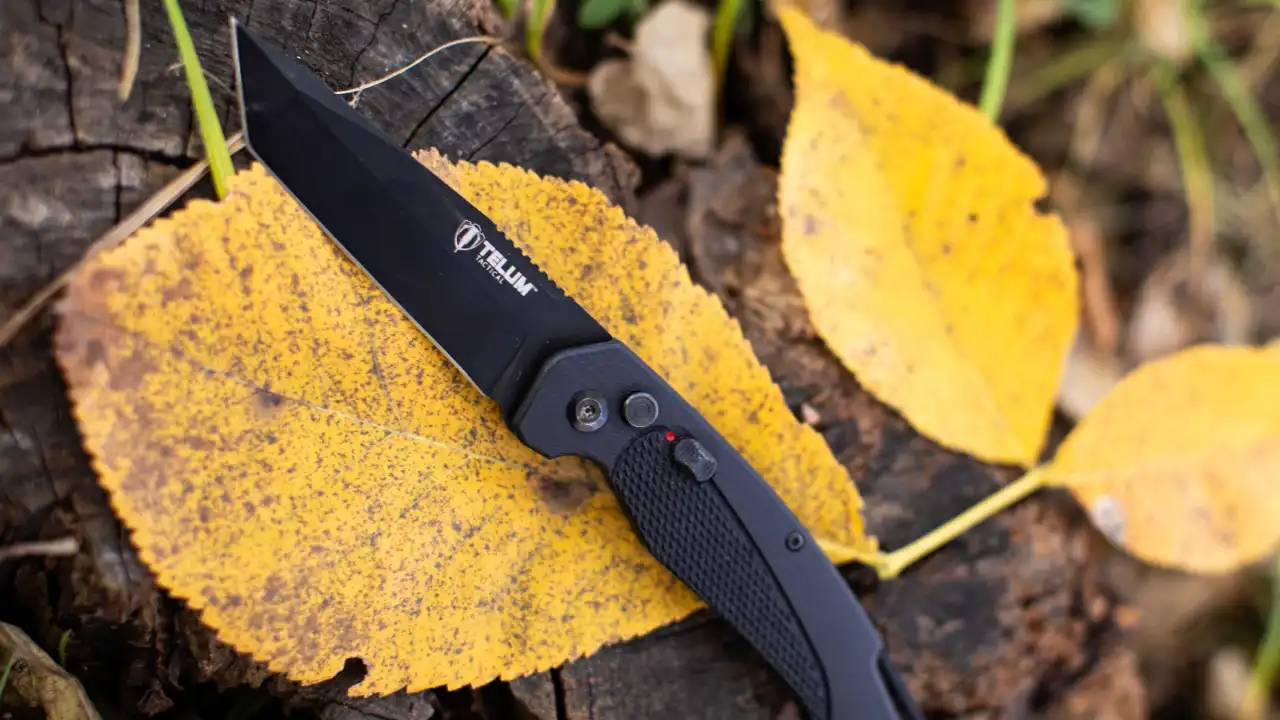
The Aftershock knife is built for users who need rapid deployment and hard-use performance in a compact package. It runs a 3.5″ D2 black titanium-coated tanto blade with a flat grind, a profile designed for piercing, controlled cutting, and edge retention under sustained pressure. The contoured black G10 handle locks into your grip and holds there, even in wet or cold conditions.
At 4.5″ closed, it sits flat in a pocket or on a belt clip without printing, and the safety lock keeps the blade secured until you need it. For law enforcement, outdoorsmen, and serious EDC users who want a knife that deploys fast and holds up hard, the Aftershock is the one to reach for.
The Dominator PLX folding knife takes a different approach. It’s 4.0″ D2 satin stone-washed clip blade is built for versatility across the full range of camp and field tasks, from processing cordage and food to general utility work that accumulates over a long day outside. The PLX locking mechanism, a crossbar-style axis lock, holds the blade solidly in place under load.
G10 handles provide a machined ergonomic grip that holds up across extended use, and the reversible tip-up pocket clip gives you carry flexibility whether you run it strong-side, off-side, or on a pack strap. At 4.5″ closed, it carries easily every day without giving up the blade length needed to handle real work in the field.
Built by Veterans. Backed for Life.
Telum Tactical is a veteran-owned operation assembled in Minden, Louisiana. Every knife in the lineup is built to a standard set by people who have needed their gear to perform, and every blade is backed by a lifetime warranty because that is what standing behind your work actually looks like.
Ready to build a kit you can count on? Explore tactical knives now and find the Telum model built for your mission. Need a folder that moves from everyday carry to outdoor use without compromise? Shop the Dominator PLX and see what that standard delivers.