








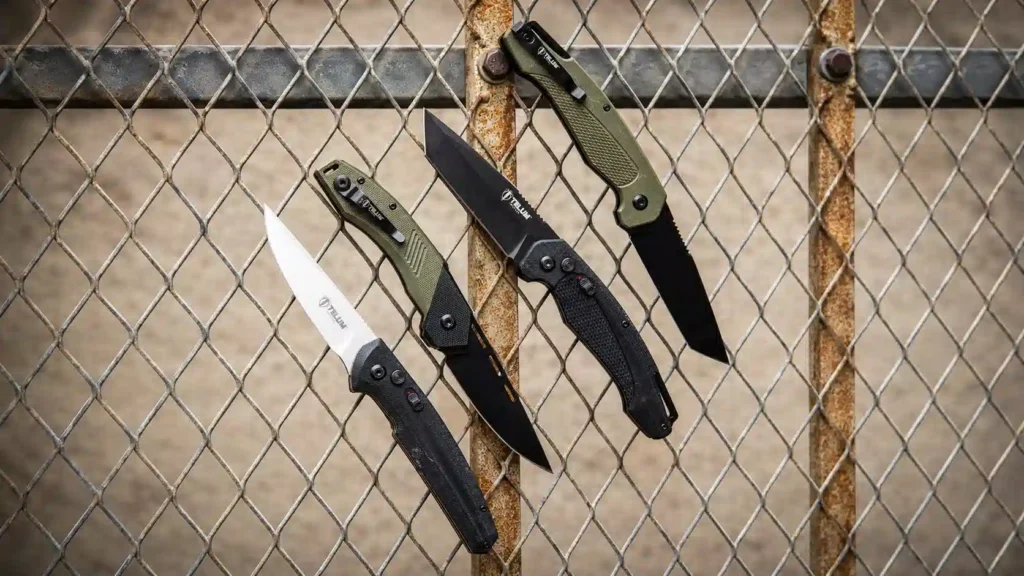
Most people shop for a knife the way they shop for a car. They check the horsepower first. In knife terms, that means the steel: how hard it is, how long it holds an edge, what letters and numbers are stamped on the spec sheet. The handle gets a glance, maybe a color preference, and that’s it.
That’s backward. According to a joint ergonomics guide from NIOSH and Cal/OSHA, a secure grip depends on sufficient friction between the hand and the tool, and selecting a handle with a non-slip surface is one of the clearest ways to reduce the effort needed to use a tool safely.
That’s the bar we build every handle to. The principle doesn’t stop applying just because the tool in question folds into your pocket. The best knife handle materials are the ones that keep that grip secure when your hands are wet, cold, or tired, not just when you’re admiring the knife on a countertop.
This is a decision guide, not a materials glossary. The goal is matching a handle material to how you actually carry and use a knife, not memorizing a chart of specs you’ll never reference again.
Why Handle Material Changes the Way a Knife Performs
A blade can be sharp, hard, and beautifully ground, and still feel wrong in your hand. Handle material affects grip security, control while cutting, comfort over a long day of carry, and confidence when conditions turn less than ideal. None of that shows up in a steel comparison chart.
We treat handle material as a core engineering decision on every knife we build, not an afterthought. A knife that photographs well but slides in your palm the first time your hands sweat isn’t a compromise you should accept.
The Three Conditions That Expose the Weakness of a Handle Material
Most handle materials look fine in a store. The real test comes later, in three specific situations most buyers never think to check for before they purchase.
Wet or sweaty hands strip away whatever grip a smooth or glossy surface was providing. Cold weather stiffens some materials and makes others feel harsh against skin. Repeated daily carry, months of pocket friction, and keys and coins rubbing against the same surface wear down finishes that looked durable on day one.
A handle that passes all three isn’t lucky. It was engineered to.
Handle Materials That Buyers Compare Most Often
Six materials come up again and again once you start comparing knives seriously.
G10 is a fiberglass laminate, pressed and cured under heat, prized for being lightweight, rigid, and moisture-resistant. It’s the material our own duty and EDC lineup has standardized on, and the next few sections explain why. Aluminum offers a sleek, machined feel and takes anodized colors well, though it can turn cold and slick faster than other options.
Polymer and FRN (fiberglass-reinforced nylon) keep cost and weight down while flexing slightly under pressure, a trade-off some users prefer for comfort and others trade for a stiffer feel. Carbon fiber is prized for its low weight and premium look, but its grip depends heavily on the weave and finish. Micarta, layers of linen or canvas set in resin, is a favorite among people who work outdoors because it tends to grip better, not worse, once it’s wet.
Each of these creates a genuinely different feel in the hand. None of them is universally correct.
Which Handle Material Gives the Best Grip?
Grip comes down to two things working together: the material itself and how it’s textured and shaped. A premium material can still feel slick if the surface is smooth and polished, and a simpler material can perform just as well if it’s aggressively textured and properly contoured.
This matters most under pressure. Wet hands, gloved hands, and high-force cutting all expose a handle that relies on looks instead of engineering. Lightweight doesn’t automatically mean secure. Some of the lightest handle materials on the market are also the most likely to feel slick the moment moisture gets involved.
The Glaive is built around exactly this priority: its compact frame is shaped to put as much handle in your palm as possible without adding bulk, so grip doesn’t get sacrificed for a smaller footprint.
The Incinerator takes a more direct approach with contoured, two-part G10 scales, a material chosen specifically because its texture holds up when hands are wet or gloved, not just when everything’s ideal.
Which Handle Material Holds Up Best Over Time?
Durability isn’t just about the raw material resisting cracks and chips. Pocket carry abrasion, repeated opening and closing, and years of handling all test a handle differently than a single drop test would. Thickness, scale design, and construction quality determine whether a handle ages gracefully or starts to look rough after a year of real use.
Our own G10 handles are bonded and finished to that standard, built for years of carry rather than picked for a single strong first impression.
Which Handle Material Feels Best in Daily Use?
This is the category most buying guides underdevelop, and it’s often the one that actually decides whether you keep carrying a knife. Hand fatigue over a long day, how a material feels in extreme heat or cold, weight balance in your pocket, and texture that grips without abrading your skin all compound over months of carry in ways a five-minute store test can’t reveal.
Our G10-handled knives use a contoured, two-part design rather than a flat scale for exactly this reason, built around comfort over a full day of carry.
When Lightweight Matters More Than Maximum Toughness
Not every knife needs to survive a demolition site. If you carry a knife every day for utility tasks, mail, tape, cordage, the deciding factor often isn’t which material can survive the most abuse. It’s which one you forget is in your pocket.
That’s the trade-off behind knives like the Aftershock, built for everyday carry without excess bulk. The right handle material here isn’t the toughest one on paper. It’s the one that disappears into your routine instead of becoming something you have to think about.
The Material Mistakes That Make a Good Knife Feel Wrong
A few patterns show up again and again in buyer’s remorse. Choosing a handle because it looks striking in a product photo, ignoring texture and contour entirely, assuming an exotic-sounding material automatically outperforms a common one, and buying a knife suited for one scenario while carrying it in a completely different one.
None of these mistakes are about bad judgment. They’re about a spec sheet not telling you what a handle actually feels like after month three. Every knife we build carries a lifetime warranty for this reason, so a mismatched pick doesn’t have to be a permanent one.
Best Handle Material by Use Case
For grip under stress, look for aggressively textured G10 or micarta. For lightweight everyday carry, FRN or a well-shaped polymer often outperforms heavier options you’ll notice all day. For comfort over long stretches of use, a contoured handle with moderate texture beats an aggressive pattern that starts to bite into skin after hours. For rugged daily use, two-part G10 with a properly bonded construction holds up better than most alternatives.
For a premium feel that doesn’t sacrifice function, textured carbon fiber or finished micarta both deliver without becoming decorative-only choices. This is roughly the logic our own lineup follows, matching material to use case rather than defaulting to one option across the board.
What Matters More Than the Material Name on the Spec Sheet
Texture, contouring, thickness, finish, and overall shape decide more about real-world feel than the material name alone. Two knives built from identical G10 can feel completely different in the hand depending on how that G10 was shaped and finished.
How a handle locks into your grip, whether it fills your palm naturally or leaves gaps, matters as much as what it’s made from. The two-part shaping on our own G10 handles follows this same principle, built to fill the palm rather than leave gaps at the back of the grip.
Where to Find Knives Built for Real-World Handle Performance
Good handle design isn’t one decision. It’s material, texture, and shape working together, and it shows up the moment you actually use the knife instead of just holding it. The Dominator PLX pairs G10 handles with a PLX crossbar lock specifically to keep grip and lockup secure under real pressure, not just in a showroom.
Why Telum Tactical Knives Are Built for Control, Comfort, and Reliability
Every knife we build is assembled in Minden, Louisiana, and backed by a lifetime warranty that doesn’t change depending on where the knife came from, because every knife came from the same place. As a veteran-owned member of the Rock Ridge Outdoors family, we design knives for people who carry one for a living or carry one every day because preparedness matters to them.
Our core duty and EDC knives, including the Incinerator, Aftershock, Scorch, and Dominator PLX, use contoured, two-part G10 handles for exactly the reasons covered above: consistent grip in wet or gloved conditions, resistance to pocket wear, and a shape that holds up to years of daily carry.
Pair that with D2 and S35VN steels across the lineup, and the handle material stops being a separate decision from the rest of the knife. It’s part of the same standard.
Frequently Asked Questions
What is the best knife handle material for grip?
Aggressively textured G10 and micarta consistently perform best for secure grip, especially in wet or gloved conditions, because their surface texture is engineered to resist slipping rather than relying on the material alone. The G10 handles on our Incinerator and Aftershock follow this same logic.
Which knife handle material is most durable?
Properly constructed G10 holds up exceptionally well over years of daily carry, resisting cracking and wear better than lighter synthetic options, provided the construction quality behind it matches the material. Our own duty knives are engineered around exactly that: G10 scales bonded for long-term wear rather than picked for a single strong first impression.
Are aluminum knife handles too slippery?
Aluminum can become slick when wet or cold unless it’s textured or given an aggressive finish. Hence, an untextured aluminum handle is a real risk in demanding conditions, while a properly finished one performs reasonably well.
Is G10 better than micarta?
Neither is universally better. G10 tends to be lighter and more rigid, while micarta often grips better once it’s wet. Our own lineup leans on G10 for that combination of light weight and consistent grip, though micarta remains the sharper pick if wet-condition traction is the top priority.
What handle material is best for everyday carry?
For most everyday carry, a well-shaped G10 or FRN handle balances weight, durability, and grip without asking you to compromise on any single factor. The Aftershock and Scorch are both built around that balance.
Ready to Find a Knife Built for How You Actually Carry?
Choosing the right handle material means the knife performs the same way on day one thousand as it did on day one, whether your hands are dry, wet, gloved, or cold. Every knife in our lineup is built to the same G10, D2, and S35VN standard, backed by a lifetime warranty that doesn’t change knife to knife.
Shop automatic knives built for real-world carry and find the handle material that fits how you actually use a knife.